
 Crypto has opened doors for a lot of people, real trading opportunities, real technology, real wealth building for those who know what they’re doing. But that same excitement has also become the perfect cover for old school scams wearing a new costume. A Ponzi scheme from the 1920s and a “crypto investment platform” from last week can run on the exact same trick, just with different branding.
If you’ve ever been added to a group chat promising 20% weekly returns, or a friend of a friend keeps posting screenshots of their “profits,” this one’s for you. Here’s how these schemes actually work, and the warning signs that should make you pause before sending a single peso.
The Core Trick Never Changes
A Ponzi scheme doesn’t make money from real investments. It pays old investors using money from new investors. That’s it. There’s no trading algorithm, no arbitrage strategy, no secret crypto mining operation generating those returns. It’s just a cycle of new deposits paying out old withdrawals, and it works exactly like a house of cards. It looks stable right up until new money stops coming in, then the whole thing collapses at once.
What makes the crypto version dangerous is that blockchain jargon gives scammers instant credibility. Words like “smart contract,” “liquidity pool,” “staking algorithm,” and “AI trading bot” sound technical enough that most people won’t question them. The complexity itself becomes the disguise.
Red Flag 1: Guaranteed Returns
 Real investing, crypto or otherwise, involves risk. Prices go up, prices go down, and nobody can promise you a fixed percentage every single week or month. If a platform guarantees returns like 10% weekly or “double your money in 30 days,” that’s not a bold trading strategy. That’s a mathematical impossibility dressed up as an opportunity.
No legitimate fund, hedge fund, or crypto exchange in the world can promise consistent fixed returns regardless of market conditions. If they could, they wouldn’t need your money, they’d just borrow from a bank at a fraction of the cost and keep all the profit for themselves.
Red Flag 2: You Earn More by Recruiting
 This is the biggest tell of all. If the platform’s compensation plan rewards you for bringing in new investors, layers of referral bonuses, “unlock higher tiers by recruiting,” team building bonuses, that’s not an investment product. That’s a pyramid structure wearing crypto as a mask.
Ask yourself a simple question: does this platform make money from an actual product or service, or does it make money from people signing up other people? If the answer leans toward recruitment, walk away.
Red Flag 3: Vague or Missing Business Model
 Ask a legitimate crypto project how it generates yield and you’ll get a real answer, staking rewards from validating a blockchain, fees from a decentralized exchange, lending interest from a protocol you can actually verify onchain. Ask a Ponzi scheme the same question and you’ll get buzzwords. “Our proprietary AI trading system.” “Arbitrage across multiple exchanges.” “Our expert traders.” No specifics, no verifiable data, no audited smart contract you can actually check yourself.
If you can’t explain in one sentence exactly how the platform generates its returns, that’s a problem. And if their explanation only makes sense after three more follow up questions, that’s also a problem.
Red Flag 4: Pressure and Urgency
 Scammers love deadlines. “Slots are limited.” “Bonus doubles if you deposit before midnight.” “Price of the token goes up tomorrow.” This pressure exists for one reason, to stop you from thinking clearly and doing your own research. Legitimate investment opportunities don’t disappear in 24 hours. If something is rushing you into a decision, that urgency is the scam talking, not the opportunity.
Red Flag 5: Withdrawal Problems
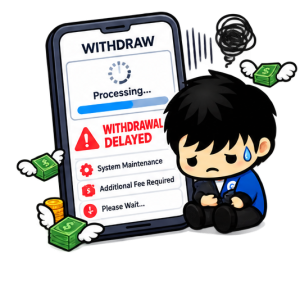 This is usually where things fall apart, literally. Early on, withdrawals process smoothly, sometimes even fast, because the scheme needs your trust and your testimonials. But as the scheme matures, withdrawals start getting delayed. Then there are sudden “maintenance” periods. Then new fees appear before you can cash out. Then the app just stops loading altogether.
If a platform makes it incredibly easy to deposit but suddenly complicated to withdraw, that gap between the two experiences tells you everything you need to know.
Red Flag 6: Fake Social Proof
 Screenshots of huge payouts, staged testimonial videos, influencers who clearly got paid to promote a coin they never mention again after the collapse, these are all manufactured trust. Anyone can screenshot a number. Anyone can record a testimonial. None of it proves the platform is real, and none of it should be the reason you invest your own money.
Look instead for things that are harder to fake: an actual working product you can test yourself, a public and verifiable smart contract address, a team with real identities and a track record, and reviews from independent sources rather than the platform’s own community.
What You Should Actually Do Before Investing
Before putting money into any crypto platform, run through a short checklist. Search the project name plus the word “scam” and see what comes up. Check if the smart contract is verified and publicly viewable on a blockchain explorer. Look up whether the team behind it uses real names and has a history in the industry. Read the whitepaper and ask if the numbers actually make sense mathematically, or if they only work if new money keeps flowing in forever.
And maybe the simplest rule of all, if the returns sound too good to be real, they usually aren’t. Crypto can absolutely build wealth, but it does that through real market movement, real technology, and real risk, not through guaranteed weekly payouts that no legitimate market can sustain.
Protecting yourself here isn’t about becoming a crypto expert overnight. It’s about slowing down long enough to ask the right questions before your money is gone for good.