
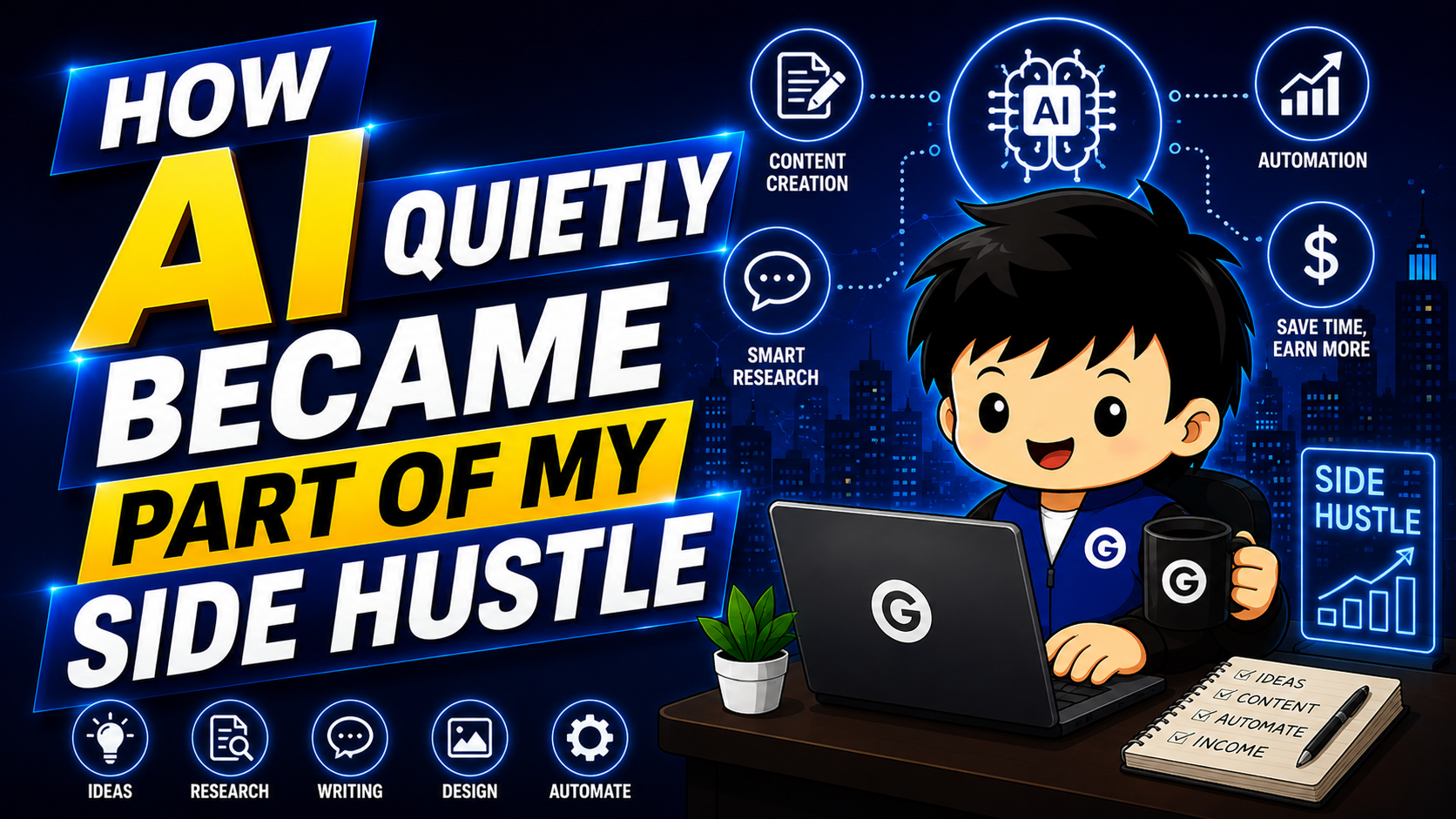
I still remember the exact night I opened ChatGPT for the first time. It was almost 1 AM. I had a client deadline the next morning, and I was staring at a blank Canva file with absolutely no ideas left in my head. After more than fifteen years in graphic design, I still hit that wall sometimes. You know the one. Your creativity just taps out, your brain refuses to cooperate, and suddenly even the simplest design feels impossible. That night, out of pure desperation, I typed a random prompt just to see what would happen.
The result wasn’t perfect. It was a little generic and definitely sounded robotic. But it gave me something I desperately needed at that moment: a direction.
A starting point.
And honestly, that was enough. I took the idea, changed it, added my own thinking, worked on the design, and eventually finished the project before sunrise. I didn’t know it at the time, but that night became the beginning of something bigger.
Not some dramatic career pivot. Not me suddenly becoming an “AI expert.” It was simply a tired designer finding a new way to get unstuck. Fast forward to today, and AI has quietly become part of how I earn money, not just how I work.
I want to share what that actually looks like in real life, without the “AI will make you a millionaire overnight” nonsense that seems to flood social media every day.
The Side Hustles I Actually Tried
1. AI-Powered Content and Blogging
This one felt like a natural fit for me because I already run websites such as gL3nnx.net and DigiQuest.
I use AI tools to help me research faster, organize my thoughts, brainstorm ideas, and get past that blank-page paralysis.
But I don’t simply generate an article, publish it, and walk away.
I still write in my own voice. I still edit. I still fact-check. I still decide what stays and what gets deleted.
AI mainly helps me get from “I have no idea what to write” to “Okay, now I have something I can work with.”
There are also different ways a blog can eventually make money, including display advertising, sponsored content, digital products, and affiliate marketing.
Affiliate marketing is particularly interesting because you can recommend tools or products that you genuinely use.
For example, some AI and creator platforms have official affiliate programs:
- ElevenLabs Affiliate Program offers commissions on qualifying paid referrals. Their current program states 22% for the first 12 months on several creator plans.
- Writesonic Affiliate Program currently advertises 20% recurring commission for up to 12 months.
- Jasper Affiliate Program has an official affiliate program, with its published agreement describing commissions on qualifying subscriptions.
- VEED Affiliate Program also offers an affiliate program for creators and publishers, including recurring commissions.
That’s where blogging can become more interesting.
One article probably won’t make you rich. Ten articles probably won’t either.
But if you build useful content around topics people are actually searching for, and some of those articles continue bringing visitors months later, you can potentially create an income stream that doesn’t require you to start from zero every single day.
That’s the part I find interesting.
2. AI-Generated Video Content for Social Media
I’ve also been experimenting with AI video tools such as Kling, Veo, and Runway to create short cinematic clips.
As someone who creates Reels and social media content, this part genuinely excites me.
There’s something fascinating about describing a scene and watching software turn that description into something that looks like a tiny movie.
Sometimes it works beautifully.
Sometimes it produces something completely ridiculous.
And sometimes you spend more time fixing the result than you would have spent making the thing manually.
That’s the reality.
The AI video space moves incredibly fast. A workflow that feels impressive today can look completely ordinary a few months later.
So I don’t look at it as a shortcut.
I look at it as another creative skill.
The goal isn’t to let AI make everything for me.
The goal is to learn how to direct it.
3. Selling AI-Enhanced Design Services
This one is probably the closest to home because graphic design is still my actual profession.
AI has helped me speed up certain parts of the design process, especially things like brainstorming, mockups, background removal, image variations, and generating rough concepts before I take over in Photoshop or Illustrator.
And this is something I think people sometimes misunderstand.
Clients don’t really care that you used AI.
They care about the result.
They care whether the design looks good.
They care whether you understand their brand.
They care whether you deliver on time.
They care whether you can take their vague idea and turn it into something usable.
AI doesn’t automatically give you those skills.
I’ve spent years learning composition, typography, color, branding, layout, client communication, and all the little things that make a design actually work.
AI simply gives me another tool to use.
And sometimes, that tool helps me get the job done faster.
4. Affiliate Marketing Around AI Tools
This is another area I’ve been exploring. There are thousands of people curious about AI tools, but many of them don’t know which tools are actually useful. That’s where content can help.
Instead of writing, “This AI tool is amazing, go buy it,” you can create something genuinely useful:
“I tested this AI video tool for 30 days. Here’s what worked and what didn’t.”
Or:
“Best AI voice generators for YouTube creators.”
Or:
“ElevenLabs vs. other AI voice tools: Which one is actually worth paying for?”
Then, if the company has an affiliate program, you can include your referral link with a clear disclosure.
For example, ElevenLabs explicitly operates a creator affiliate program, and Writesonic currently offers recurring commissions for qualifying referrals.
The important part is honesty.
If the product is bad, say it’s bad.
If it’s expensive, say it’s expensive.
If you found a better alternative, mention it.
People are much more likely to trust you when they feel you’re actually trying to help them instead of simply trying to get their click.
What Nobody Tells You About This
Here’s the part that took me a while to accept.
AI does not replace effort.
It replaces some of the tedious parts of the work.
The repetitive parts.
The parts that used to consume your energy before you even got to the interesting stuff.
I still remember feeling a strange mix of excitement and guilt the first time AI helped me finish a project much faster than usual.
I was excited because I thought, “Wow, that used to take me three hours.”
But there was also this little voice in my head asking:
“Do I even deserve to get paid for this if it was so easy?”
Eventually, I realized how silly that question was.
The fifteen years of design experience didn’t come from AI.
The client handling didn’t come from AI.
My design taste didn’t come from AI.
Knowing what looks good and what doesn’t didn’t come from AI.
Knowing when to ignore the client’s first idea and suggest something better didn’t come from AI.
Those things are still mine.
AI just gives me a faster brush.
I’m still the one painting.
If You’re Thinking About Starting
Don’t chase every shiny AI tool that pops up on your feed.
There are new ones almost every week.
Instead, start with something you already know how to do or something you genuinely enjoy.
Then ask yourself:
“Where can AI make me better or faster at this?”
If you’re a writer, use AI to help with research and brainstorming.
If you’re a designer, use it for ideation, variations, and repetitive tasks.
If you’re a video creator, experiment with AI video, voice, and editing tools.
If you already have a website, consider creating useful tutorials, comparisons, and reviews around the tools you actually use.
And if you decide to use affiliate links, always check the company’s current affiliate terms before promoting anything.
For example, affiliate programs can have rules about disclosures, advertising, trademarks, paid search, and where you’re allowed to promote your links. ElevenLabs and Jasper both publish specific affiliate requirements, while Writesonic also has restrictions around branded advertising.
You don’t need to become an AI expert overnight.
You don’t need twenty different subscriptions.
You don’t need to buy a $997 “AI passive income system.”
Start with one skill.
One tool.
One small project.
Maybe it’s one blog post a week.
Maybe it’s one AI-assisted Reel a month while you learn the tools.
Maybe it’s simply using AI to speed up the work you’re already getting paid to do.
That’s enough.
And be patient with yourself.
I’ve had nights where the AI output looked amazing.
I’ve also had nights where it looked like absolute garbage and I had to redo everything manually.
That’s normal.
Building something new usually looks like that.
Final Thoughts
AI side hustles aren’t magic money machines, no matter how many people online make them sound that way.
But when you combine AI with an actual skill, experience, patience, and a willingness to learn, it can open doors that weren’t as easy to access before.
It can help you work faster.
It can help you experiment more.
It can help you create things that would have taken considerably more time before.
And, if you build the right system around those skills, it can potentially create additional income streams as well.
That tired designer staring at a blank Canva file at 1 AM had no idea where that random prompt would eventually lead.
Funny how the smallest and most desperate moments sometimes turn into the biggest turning points.
If you’re on a similar road, don’t worry about figuring everything out at once.
Just take it one honest step at a time.
That’s really all any of us are doing.